Wednesday, 6 November 2013

Hacking Online Casinos with Casino Hacking Software Kit by Hackingloops


Have you ever thought Online Casinos can be Hacked? If not, then start now because Hackingloops team has done it. Hackingloops team has made an Casino Hacking Software Kit which will hack the casinos and will generate profits of at least 60$ - 600$ per hour depending upon the Packages. Note: This is limited period offer only for Hackingloops readers. Casino Hacking Software Kit supports following games Roulette, Slot Machines, Blackjack, Scratch card games, KENO. Note: Current version of Hack does not support Poker but it will soon cover that too. Also Casino Hacking Kit can only be used at Online Casinos powered by Playtech. Don't worry there are 70+ Online Casinos which uses Playtech Casino Softwares and Games. So let me give you some idea about online casinos and Casino Hacking Kit. Don't miss this!

KNOW MORE ABOUT CASINO HACKING KIT

Casinos are basically the gambling houses, where users gamble to earn huge amount of money. But most of times they end with loosing handsome amount of money. This is what makes the casinos a multi billion dollar industry. As we all know everything is nowadays moving to online web world, so is the casinos. Now we can play almost all physical casino games(like Roulette, Slot Machines, Blackjack, Poker, Keno etc.) online on online casinos. Most casinos claims that they have payouts of 83% to 97% in their yearly audits but we all don't know what actually is this? This percentage payout is actually something like say 1000 players played 10$ each for year on particular gambling machine, means 1000X10=10000$ is in inside machine now 83% payout means 83% of 10000$ and that means only 8300$ as output which implies 8300$ will be distributed among player who are lucky to win that can be 1 in 1000 or 5 or 10 and Online casino companies profit is 1700$ no matter who wins or loose. So they are always at profit and 95% players are always at loss. From last few days our Hackingloops team was busy on targeting Online Casinos and after 40 days of rigorous analysis and hacking attempts we are able to perfect the Hack for online Casinos and make an average of 60$ to 600$ per hour(depending upon the package you choose i.e. Bronze Package makes 50-100$/hr, Silver Package makes 300-450$/hr and Diamond Package makes 500-600$+/hr). That sounds crazy but it does. Currently we are offering Casino Hacking Kit for Casino games namely Roulette, Slot Machines, Blackjack, Scratch Card games. Note: Poker is not currently a part of Hacking Kit because we are still in cracking phase of Poker RNG(Random number generation) algorithm but we will be adding it soon to Casino Hacking Software Kit. Let me give you brief what you will get inside the Casino Hacking Kit sponsored by Hackingloops.

online casino hacking software Kit
Online Casinos Hacking Software Kit


Some important features of Casino Hacking Kit by Hackingloops:
  • Autoplay Bot with Maximum Profit auto config settings.
  • Casino Hacking Kit makes 60$ - 600$ Profits per hour depending upon the Package you choose.
  • Anti - Cheat Detection Feature Inbuilt to protect players from getting caught.
  • RNG Patches for Slot Machines, Roulette, Blackjack and KENO games.
  • Play for Buddy feature where one of 9 members of Hackingloops will play on behalf of user to recover all the money lost by player and will make atleast 500$ profits for player.
  • Super Money Back Program : If you are not satisfied with the Casino Hacking Kit by Hackingloops you will get all you money back in 48 hours i.e. Package Cost + Deposited Amount + 50$ SMBP reward for customer satisfaction.
  • 70+ Casinos Supported by Hack be precise all Online Casinos who users Playtech Casino Softwares and games are supported.
  • Will make atleast 150$/hr with all the slot machines and KENO games.
  • Till date sold 40+ copies of Hack and till now 0 complaints at all. You can go through testimonials of user that purchased our Casino Hacking Kit.

KNOW MORE ABOUT CASINO HACKING KIT


Casino Hacking Software Kit Includes:

1. Roulette Auto Play Bot 
Roulette is one of the most popular game in Casinos world. We will provide you with Roulette auto play bot which will place bets automatically that means no user interference at all. This bot will place bets on your behalf. Note: There are lot of free roulette bots available online, but none will give you guarantee that it will make money for you, all comes with warning that Roulette bot will not provide any damages or guarantee if player loses. That sucks! But be cool, we are giving guarantee with Super Money Back Campaign which in explained down in article.

2. Auto Config Roulette bot Maximum Win Settings 
This is what will make your roulette bot different from the others. We will provide you settings for our roulette bot which will provide you maximum profits with anti - cheat mechanism to fulfill the wagering requirements for payout. This will also protect you from getting caught online because there is no regular pattern.

3. Roulette RNG(Random number generation) Patch
We all know all Roulette Machines are based on RNG algorithm that means there is piece of code which generates random numbers between 0-36 counting 0 twice that means 38 numbers. All online casinos regularly updates(means updates usually on weekly basis or fortnight basis or in emergency) their random number generation algorithms and 99% Hacks fail after that. So in order to make continuous profits user need to update their RNG algorithm patch as per casino updates. Don't loose you cool and leave that to us, as we will update and send the regular patches to all our customers on regular basis i.e. as soon as its updated.

4. Slot Machines Random Generation Patch which maintains profits of 150$+/hr.
Slot machine RNG algorithms are little different from the roulette RNG's. Roulette RNG's are based on PRNG i.e. Pseudo RNG that means it repeats itself after sequence is over. Well sequence is generally 1 Million numbers (depends upon casino software provider to provider, also its not exact 1 Million its somewhere near around it) long on an average that means after 1 million numbers the sequence will repeat itself. While Slot Machines have different Mechanism, Considering a 5-reel Slot Machines with 25 lines and 8 different cards and 1 scatter card and 1 wild card that makes 9 unique and 1 wild card that can comprise of all. Normally people thinks that position of all cards is fixed in vertical lines but that's a myth because all 9 unique cards are randomly rotated for each slot i.e. in 5 reel (i.e. 15 different slots, 9 unique cards and 1 wild card) means 15XFactorial 9XFactorial 10 outcomes of 1 simple spin. So its quite hard to beat such Random Generation Patch but where there is hope there is way. Most casinos launch campaigns to attract new customers and for new customers usually Payout is high i.e. near 130%. But regularly new customers adds up to casino's and how they maintain this?? Answer is quite simple, they use multiple Data Servers and Gaming engines. With our through analysis we are able to identify the highest payout dataservers and hence we can maintain a profit of 150$+/hr.

5. All in one Casino Games Patch
This is similar to above concept. This patch will connect you to those dataservers in which Payout is high i.e. means win win situation.

6. Silver and Diamond Packages include Play for buddy feature where profits will be shared in 50:50 ratio.
Wow this is something unique, not all online casino players are that smart and sometimes there can be losses. To make every person earn who have invested in our Software Kit, we came with offer Play for buddy. In this one of 9 members of Hackingloops will play via Team viewer on your behalf and all profits will be shared in 50:50 ratio. Say our Player makes 1000$ profit then 500$ will be given to you and 500$ will be Hackingloops member share.

7. Super Money Back Campaign
That's the best part of our Package. Suppose any how you are not able to win with our Casino Hacking Software Kit. We will give you back all your money back + money invested in casino + 50$ bonus money. But that valid for first 15 days of purchase only. Don't worry if you play as guided you will make more that 5000$ with the hack in your first week. 


Last few words about Casino Hacking Software Kit, if you miss it you will miss best chances to make money from online casinos. 

Casino Hacking Kit Package costs 100$( Bronze Package), 200$ (Silver Package) and 250$ (Diamond Package). This might sounds little costly to new users but by you can recover that money in less than 2 hours by playing with our Casino Hacking Kit. Note: If you face problems with setup we will provide you Team viewer Support online and will setup it in your Machine. 

If you are not satisfied with the Casino Hacking Kit, then just send us a message that you are not satisfied with the Hack and snapshots of all deposits you make, you will be eligible for Super Money back Campaign and will get your money back withing 2 days.

Why Waiting? Go Ahead and Buy Casino Hacking Kit Now. Its now or never.

Actually waiting is just waste of Time and Money! This is initial sales campaign and we gonna increase our prices after first 200 sales. So Buy Casino Hacking Kit Now!
 
BUY CASINO HACKING KIT NOW 
or
KNOW MORE ABOUT CASINO HACKING KIT

Still scared! Another offer for first 50 buyers. First 50 buyers will get No deposit referral bonuses of at least 25$ as initial deposit at all Playtech Casinos and first 20 will get play with buddy feature and hidden bonuses.

Enjoy!

Read more: http://www.hackingloops.com/2013/10/hacking-online-casinos-with-casino-hacking-software-kit.html#ixzz2juAoQ9gE

11 Firefox Addons a Hacker Must Have and use


Firefox is one the most secured web browser in the world. Have you ever dreamed of that we can use Firefox to Hack like a pro? Firefox like other browsers has a feature called add-on. Add-ons adds an additional functionality to your Firefox browser. There are thousands of Firefox add-ons available for Mozilla but Hackingloops brings you the best and most effective Hacking add-ons ever on Firefox. In short, we are listing a most popular and interesting Firefox add-ons that are useful for Hackers. This list of 11 add-ons vary from information gathering tools to attacking tools. All these add-ons are available for free and you can download from the Mozilla add-on website. So friends lets see what Hackingloops has bring this time for you. I will list them in way from top( I like most) to bottom pattern but note that all of them are extremely good tools.

Firefox addons for Hackers
Firefox Add-ons for Hackers

11 Firefox Add-ons a Hacker Must Have and use


1. Tamper Data
Tamper data is an great tool to to view and modify HTTP/HTTPS headers and post parameters. We can alter each request going from our machine to destination host with this. Thus it helps in security testing web application by modifying POST parameters. It can be used in performing XSS and SQL Injection attacks by modifying header data.
Add Tamper data to Firefox:
https://addons.mozilla.org/en-us/firefox/addon/tamper-data/

2. Firebug
Firebug is a nice add-on that integrates a web development tool inside the browser. With this tool, you can edit and debug HTML, CSS and JavaScript live in any webpage to see the effect of changes. It helps in analyzing JS files to find XSS vulnerabilities. It’s an really helpful add-on in finding DOM based XSS for security testing professionals.
Add firebug to your browser :
https://addons.mozilla.org/en-US/firefox/addon/firebug/
 
3. Hackbar
Hackbar is a simple penetration tool for Firefox. It helps in testing simple SQL injection and XSS holes. You cannot execute standard exploits but you can easily use it to test whether vulnerability exists or not. You can also manually submit form data with GET or POST requests. It also has encryption and encoding tools. Most of the times, this tool helps in testing XSS vulnerability with encoded XSS payloads. It also supports keyboard shortcuts to perform various tasks.I am sure, most of the persons in the security field already know about this tool. This tool is mostly used in finding POST XSS vulnerabilities because it can send POST data manually to any page you like. With the ability of manually sending POST form data, you can easily bypass client side validations of the page. If your payload is being encoded at client side, you can use an encoding tool to encode your payload and then perform the attack. If the application is vulnerable to the XSS, I am sure you will find the vulnerability with the help of the Hackbar add-on on Firefox browser.
Add Hackbar to Firefox:
https://addons.mozilla.org/en-US/firefox/addon/hackbar/

4. Cookies Manager +
Cookie Manager is one of the greatest tool ever made. Using this tool you can actually play with cookies. You can alter almost all cookie using this tool. You can use Cookies manager to view, edit and create new cookies. It also shows extra information about cookies, allows edit multiple cookies at once and backup/restore them.
Add Cookies Manager to Firefox:
https://addons.mozilla.org/en-US/firefox/addon/cookies-manager-plus/

5. NoScript
No Script add-ons greatness is beyond imagination. With this tool you can monitor each an every script running on website, you can block any of scripts and see what actually that scripts does on website. But this add-on is for experts, newbies will face problems using this. Note: If you are testing XSS, HTTPS header modifications, Injection attacks on any website you need to disable this plugin because it will not allow you to do so. 
Add NoScript to Firefox:
https://addons.mozilla.org/en-us/firefox/addon/noscript/

6. Grease Monkey
Grease Monkey is an counter part of No Script, its actually behaves opposite of Noscript. We use Noscript to block the scripts and use GreaseMonkey to run the scripts. It allows you to customize the way a web page displays or behaves, by using small bits of JavaScript. 
Add Grease Monkey to Firefox :
https://addons.mozilla.org/en-US/firefox/addon/greasemonkey/

7. User Agent Switcher

User Agent Switcher add-on; adds a one click user agent switch to the browser. It adds a menu and tool bar button in the browser. Whenever you want to switch the user agent, use the browser button. User Agent add on helps in spoofing the browser while performing some attack.
Add user agent Switcher to Firefox:
https://addons.mozilla.org/en-US/firefox/addon/user-agent-switcher/

8. CryptoFox
CryptoFox is an encryption or decryption tool for Mozilla Firefox. It supports most of the available encryption algorithm. So, you can easily encrypt or decrypt data with supported encryption algorithm. This add-on comes with dictionary attack support, to crack MD5 cracking passwords. Although, it hasn’t have good reviews, it works satisfactorily.
Add CryptoFox to Firefox:
https://addons.mozilla.org/en-US/firefox/addon/cryptofox/

9. SQL Inject Me
SQL Inject Me is another nice Firefox add-on used to find SQL injection vulnerabilities in web applications. This tool does not exploit the vulnerability but display that it exists. SQL injection is one of the most harmful web application vulnerabilities, it can allow attackers to view, modify, edit, add or delete records in a database.The tool sends escape strings through form fields, and tries to search database error messages. If it finds a database error message, it marks the page as vulnerable. Hackers can use this tool for SQL injection testing.
Add SQL Inject Me to Firefox:
https://addons.mozilla.org/en-us/firefox/addon/sql-inject-me/ 

10.  XSS ME
Cross Site Scripting is the most found web application vulnerability. For detecting XSS vulnerabilities in web applications, this add-on can be a useful tool. XSS-Me is used to find reflected XSS vulnerabilities from a browser. It scans all forms of the page, and then performs an attack on the selected pages with pre-defined XSS payloads. After the scan is complete, it lists all the pages that renders a payload on the page, and may be vulnerable to XSS attack. Now, you can manually test the web page to find whether the vulnerability exists or not.
Add XSS ME to Firefox:
https://addons.mozilla.org/en-us/firefox/addon/xss-me/

11.  Passive Recon
Last but not the least. Passive recon is a good information gathering tool. 
PassiveRecon provides information security professionals with the ability to perform "packetless" discovery of target resources utilizing publicly available information. It gathers information like DnsStuff tool available on backtrack.

Add Passive Recon to Firefox:
https://addons.mozilla.org/en-US/firefox/addon/passiverecon/


That's all for today guys, i hope you all are enjoying your journey towards becoming a Professional Hacker. Have fun! Keep Learning

Read more: http://www.hackingloops.com/2013/08/11-firefox-addons-hacker-must-have-use.html#ixzz2ju5qkN6W

how-to-make-phisher-or-fake-pages

Phishers are fake pages which are intentionally made by hackers to steal the critical information like identity details, usernames, passwords, IP address and other such stuff. As i mentioned intentional, which clearly means its illegal and its a cyber crime. Phishing is basically a social engineering technique to hack username and passwords by deceiving the legitimate users. Phishers are sent normally using spam or forged mails.

Note: This article is for educational purposes only, any misuse is not covered by Hacking loops or CME.

What is Phishing?
Phishing is basically derived from the word called Fishing which is done by making a trap to catch the fishes. Similarly in case of hacking, hackers make Phish pages (traps) to deceive the normal or unaware user to hack his account details. Phishing technique is advancing day by day, its really tough to believe that on what extent this technique is reached but this is always remains far away from normal internet users and most of hackers.
Most of hackers and computer geeks still believe that Phishing attempt can be easily detected by seeing the URL in address bar. Below are some myths that hacking industry still have about Phishing. I will mention only few because then article will become sensitive and major security agencies will flag my website for posting sensitive data. So i will only explain the facts, if you need the same you need to fill the form and give us assurance that you will not misuse it.

Myth's about Phishing among Computer Geeks and Hackers
1. Almost each and every Hacker or computer Geek, thinks that Phishing attempt can be detected by just having a look on the URL. Let me tell you friends it was old days when you recognize Phishers by seeing URL's. But nowadays recent development in Cross site scripting(XSS) and Cross site Script forgery has made it possible that we can embed our scripts in the URL of famous websites, and you must know scripting has no limitations. Below are some examples that you can do from scripting:
a. Embed a Ajax Keylogger into the main URL and user clicks on the URL, keylogger script will get executed and all the keystrokes of the user will get record.
b. Spoof the fake URL: If you are little bit good in scripting and web browser exploits recognition then this can be easily done. What you need to do you need to write a script which will tell web browser to open fake page URL whenever user opens some website like Facebook. Just you need to manipulate the host file and manipulate the IP address of that website from Host file(found in windows folder).
c. Simply retrieving the information saved in the web browser like saved passwords, and bookmarks etc. Just need to write a script which will explore the locations in Windows user profile (where actually the stored information of web browsers saved). 
2. One biggest myth, when you enter the data into the fake page, it will show either some warning message or show login information is incorrect. Rofl, new phishers are bit smart, now they don't show warning messages, when you login through fake page. They will actually login you into your account, and simultaneously at the back end they will steal your information using batch scripts.

So  friends i think this is enough back ground about new phishing technologies. Let's learn how to make a basic Phisher of any website in less than one or two minutes.

Steps to make your own Phisher:
1. Open the website Login or Sign in page whose phisher you want to make. Suppose you pick Gmail.
2. Right click to view the source and simultaneously open notepad.
3. Copy all the contents of the source into the notepad file.
4. Now you need to search for word action in the copied source code. You will find something like below:
How to make Phishers
Manipulate action and method

Now in this line you need to edit two things, first method and then action. Method Post is used for security purposes which encrypts the plain text, so we need to change it to GET.
Action field contains the link to next page, where it should go when you click on login or press enter. You need to change it to something.php (say lokesh.php).
5. Now save the above page.
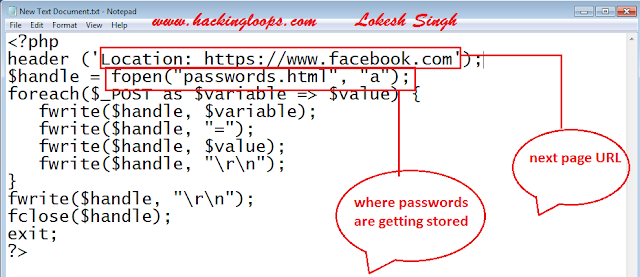
6. Now open the Notepad again and paste the below code in that:
Make batch script for Phisher
Batch script for Phisher
7. Location contains the next page URL, where you wish to send to user and passwords.html will contains the passwords.
8. Now save this file as lokesh.php as told in step number 4.
9. Now create an empty file and name it as passwords.html, where the password get stored.
10. Upload all the three file to any web server and test it.
Note: In case of facebook, it will show error after user login, for that you need to use tabnabbing trick.
Note: Always keep the extension correct, otherwise it will not work. So always use save as trick rather than save otherwise it will save files as lokesh.php.txt.

Read more: http://www.hackingloops.com/2011/10/how-to-make-phisher-or-fake-pages.html#ixzz2ju47fVUf

That's all from my side today, I hope you all enjoyed this article..
If you have any issues ask me in form of comments..

Hacking hackers phishing pages to view hacked facebook and email accounts

Welcome friends, today i am going to teach you how to see the hackers illegal phish pages password file using Google, which all the passwords of victims are stored. As we all know 99 % hackers over internet are novice hackers or simply script kiddies. They don't know the concepts and they just follow or use the material available on internet to create Phishers to Hack Facebook, Gmail or simply passwords. Which always result in creating Phisher successfully but not a secure one because none tells the after phisher technique like how to make phishers undetectable, how to protect password files where all hacked passwords are stored etc. As most of us know that Phishing is the easiest method over internet to hack Facebook and Email account passwords, so most novice hackers opt this option to hack victims passwords. In fact some professional hackers uses Phishing technique too but they are bit advanced and prefer tabnabbing(click here to learn more) over Phishing. As Hackingloops concentrates on concepts and digging the root causes. We will learn something better that no body does or tells. What loophole we are digging today?? Any idea?? No ?? So go on.

Hacking Hackers online
Hacking Hackers Phish Pages to View Hacked Facebook and Email accounts using Google

Loophole

Most of us who are webmasters i.e. people who design websites knows the concept of Google indexing but others might not have that good idea. So let me explain first. How any website results appears in Google search results? You made the website and how does Google knows you website? All search engines uses spider and crawler software's over the web to index the new websites or latest changes in the existing websites in order to give users the best latest results. And indexing of website depends on a file located at root level of all web hosting websites, if its not present Google treats as full index. Most people think that robots.txt file is used to tell Google to index your website but actually robots.txt file used to tell Google that what you want to index from your website and what you don't want. By default, robot file allow full website indexing i.e. all files are indexed even password and database files. Woooo! Here the loophole lies. Most almost all hackers uses free web hosting websites to run the Phish pages and all free web hosting websites have default robot.txt file which means when hacker uploads its phish pages, its indexed by Google. And we all know what we use to extract smart information from Google? Off course its Google Dorks. Now we have to learn how to make our own dorks to extract hackers phish page information.

Hackers edits Form redirects of any login page and change the request mode from POST to GET in order to retrieve passwords in plain text and then they stores it in simple text and html files. Today we are going to learn how to extract those password files using Google. Well there is not much to learn in it because i have already made the DORK for you, what you have to do is just enter the same in Google and you will have access to all Hackers Phish pages password files containing all the hacked password they hacked till now. 

Learn how to make Phish page online in less than two minutes:

Dork to extract all Hackers Phish Pages Password file :

inurl:"passes" OR inurl:"pass" OR inurl:"passwords" OR inurl:"credentials" -search -download -techsupt -git -games -gz -bypass -exe filetype:txt @yahoo.com OR @gmail OR @hotmail OR @rediff
Just open the Google search and enter the above dork into it, you will get all Phish page password files. 

If you want to learn how to Search Google like Professional Hacker then its a must read:

Hope you all like the noobie way to view all the hacked passwords. There are several other ways to hack the hackers in smart way. We will learn that in future tutorials.

Learn 4 different ways that hacker uses to hack Facebook accounts:

Wednesday, 30 October 2013

Dependency Walker 2.2,

Dependency Walker is a free utility that scans any 32-bit or 64-bit Windows module (exe, dll, ocx, sys, etc.) and builds a hierarchical tree diagram of all dependent modules. For each module found, it lists all the functions that are exported by that module, and which of those functions are actually being called by other modules. Another view displays the minimum set of required files, along with detailed information about each file including a full path to the file, base address, version numbers, machine type, debug information, and more.

Dependency Walker is also very useful for troubleshooting system errors related to loading and executing modules. Dependency Walker detects many common application problems such as missing modules, invalid modules, import/export mismatches, circular dependency errors, mismatched machine types of modules, and module initialization failures.

Dependency Walker runs on Windows 95, 98, Me, NT, 2000, XP, 2003, Vista, 7, and 8. It can process any 32-bit or 64-bit Windows module, including ones designed for Windows CE. It can be run as graphical application or as a console application. Dependency Walker handles all types of module dependencies, including implicit, explicit (dynamic / runtime), forwarded, delay-loaded, and injected. A detailed help is included.
Dependency Walker is completely free to use. However, you may not profit from the distribution of it, nor may you bundle it with another product.

What is New in Version 2.2:

Moved to new HTML help system and updated the help text.
Added support for MSDN 8.0 external help and updated the online help URL.
Improved Side-by-Side support that handles DLL manifests and app.exe.local files.
Updated internal information about known OS versions, build numbers, and flags up to the Vista RC1 build.

What was New in Version 2.1:

Support for Side-by-Side versioning of modules. This is a new feature introduced with Windows XP that allows applications to specify specific versions and/or locations of files it wishes to use.
Integration with Visual Studio help, MSDN help, and MSDN online to provide the ability to display detailed help for any known function.

What was New in Version 2.0:

Detection of dynamically loaded modules, including details about which module actually called LoadLibrary to dynamically load the module.
Detection of dynamically called functions, including details about which module actually called GetProcAddress to obtain the function address.
Detection of delay-load dependencies. This is a new type of dependency that was introduced with Microsoft Visual C++ 6.0. They work on Windows 95/98/Me and Windows NT/2000/XP/2003/Vista/7/8/+.
Support for 64-bit Windows modules.
Console mode that allows Dependency Walker to be ran without its graphical interface being displayed. This is useful for batch files and unattended automation of Dependency Walker features.
Command line options to configure module search order, column sorting, output files, profiling, and other settings.
Ability to monitor module entrypoints (like DllMain) looking for module initialization failures.
C++ function name undecorating to provide human readable C++ function prototypes including function names, return types, and parameter types.
User definable module search paths with support for "KnownDLLs" and the "App Paths" registry keys. Search paths can be saved and loaded from within the graphical interface or from the command line.
Ability to save a module's session to a text report file for easy viewing in any text viewer.
Ability to save a module's session to a comma separated value (CSV) file for easy importing into other applications.
Ability to save a snapshot of an entire module session to an image file, which can be loaded by Dependency Walker at a later time on any computer.
Module profiling to detect dynamic dependencies, child processes, thread activity, and exceptions. Child processes can also be profiled for their dependencies.
Ability to control what file extensions Dependency Walker will add the "View Dependencies" menu item to a file's context menu in explorer.
Added hotkeys to help match imports with exports, and modules in the list view with modules in the tree view. Also added hotkeys to locate the previous, next, or original instance of a module in the tree view.
Added some new columns to the Module List View. They include Link Time Stamp, Link Checksum, Real Checksum, Symbols, Actual Base, Virtual Size, and Load Order.
Added an OS Information dialog. This information is also saved to text and Dependency Walker Image (DWI) files.
All list views can now be sorted by icon, which provides an easy way of grouping items of similar type.
You can now search all list views for text by simply typing in a few characters to match in the currently sorted column.
Added color-coding to the module list view and log view to help highlight problems.

32-bit and 64-bit explained

Will this 32-bit software run on my 64-bit operating system? or
Will this 64-bit software run on my computer?
If you've asked these questions then this tutorial should help you to understand the concepts of 32-bit and 64-bit computing. We'll look at your computer system as three parts: the hardware, the operating system and the application programs. At the end we'll look at some of the common questions people have.

32-bit versus 64-bit

As the number of bits increases there are two important benefits.
  • More bits means that data can be processed in larger chunks which also means more accurately.
  • More bits means our system can point to or address a larger number of locations in physical memory.
32-bit systems were once desired because they could address (point to) 4 Gigabytes (GB) of memory in one go. Some modern applications require more than 4 GB of memory to complete their tasks so 64-bit systems are now becoming more attractive because they can potentially address up to 4 billion times that many locations.
Since 1995, when Windows 95 was introduced with support for 32-bit applications, most of the software and operating system code has been 32-bit compatible.
Here is the problem, while most of the software available today is 32-bit, the processors we buy are almost all 64-bit.

So how long will the transition from 32-bit to 64-bit systems take?

The main issue is that your computer works from the hardware such as the processor (or CPU, as it is called), through the operating system (OS), to the highest level which is your applications. So the computer hardware is designed first, the matching operating systems are developed, and finally the applications appear.
We can look back at the transition from 16-bit to 32-bit Windows on 32-bit processors. It took 10 years (from 1985 to 1995) to get a 32-bit operating system and even now, more than 15 years later, there are many people still using 16-bit Windows applications on older versions of Windows.
The hardware and software vendors learnt from the previous transition, so the new operating systems have been released at the same time as the new processors. The problem this time is that there haven't been enough 64-bit applications. Ten years after the PC's first 64-bit processors, installs of 64-bit Windows are only now exceeding those of 32-bit Windows. Further evidence of this inertia is that you are probably reading this tutorial because you are looking to install your first 64-bit software.

Your computer system in three parts

Now we'll look at those three components of your system. In simple terms they are three layers with the processor or CPU as the central or lowest layer and the application as the outermost or highest layer as shown below:
Processor, OS and application hierarchy


To run a 64-bit operating system you need support from the lower level: the 64-bit CPU.
To run a 64-bit application you need support from all lower levels: the 64-bit OS and the 64-bit CPU.
This simplification will be enough for us to look what happens when we mix the 32-bit and 64-bit parts. But if you want to understand the issue more deeply then you will also need to consider the hardware that supports the CPU and the device drivers that allow the OS and the applications to interface with the system hardware.

What 32-bit and 64-bit combinations are compatible and will work together?

This is where we get to the practicalities and can start answering common questions.
The general rule is that 32-bit will run on a lower level 64-bit component but 64-bit does not run on a lower level 32-bit component:
  • A 32-bit OS will run on a 32-bit or 64-bit processor without any problem.
  • A 32-bit application will run on a 32-bit or 64-bit OS without any problem.
  • But a 64-bit application will only run on a 64-bit OS and a 64-bit OS will only run on a 64-bit processor.
These two tables illustrate the same rule:

Table 1 — What is compatible if I have a 32-bit CPU?
Processor (CPU) 32-bit 32-bit 32-bit 32-bit
Operating System (OS) 32-bit 32-bit 64-bit 64-bit
Application Program 32-bit 64-bit 32-bit 64-bit
  Yes No No No

Table 2 — What is compatible if I have a 64-bit CPU?
Processor (CPU) 64-bit 64-bit 64-bit 64-bit
Operating System (OS) 64-bit 64-bit 32-bit 32-bit
Application Program 64-bit 32-bit 32-bit 64-bit
  Yes Yes Yes No

The main reason that 32-bit will always run on 64-bit is that the 64-bit components have been designed to work that way. So the newer 64-bit systems are backward-compatible with the 32-bit systems (which is the main reason most of us haven't moved to 64-bit software).
An example of backward compatibility is Windows 64-bit. It has software called WOW64 that provides compatibility by emulating a 32-bit system. See the article How Windows 7 / Vista 64 Support 32-bit Applications if you want to know more. One important point that is made in that article is that it is not possible to install a 32-bit device driver on a 64-bit operating system. This is because device drivers run in parallel to the operating system. The emulation is done at the operating system level so it is available to the higher layer, the application, but it is not available to the device driver which runs on the same level.

Hardware virtualization is the exception to the rule

Another question many people have is whether a 32-bit system can run 64-bit software. As more people are looking to use 64-bit Windows they are wanting to try it out on their existing systems. So we are getting more questions about whether they can run it on their 32-bit processor or under their 32-bit OS.
Following the general rule, we would expect that you cannot run 64-bit software on a 32-bit system. Except that there is one exception called virtualization.
Virtualization creates a virtual system within the actual system. Virtualization can be achieved in hardware or software but it works best if the virtual machine is created in the system hardware. The guest operating system is not aware that there is a host operating system already running. This is the way that a 64-bit operating system can think that it is running on 64-bit hardware without being aware that there is a 32-bit operating system in the mix.
Tables 3 and 4 illustrate the result. Provided that the virtual machine can actually be created and isolated by the virtualizing software then the host OS is effectively removed from the equation, so I've grayed it out. We can now apply the general rules for a non-virtualized system to the three remaining layers.
Table 3 — What is compatible if I have a 32-bit CPU and software virtualization?
Processor (CPU) 32-bit 32-bit 32-bit 32-bit
Host Operating System 32-bit 32-bit 32-bit 32-bit
Guest Operating System 32-bit 32-bit 64-bit 64-bit
Application Program 32-bit 64-bit 32-bit 64-bit
  Yes No No No
 
Table 4 — What is compatible if I have a 64-bit CPU and software virtualization?
Processor (CPU) 64-bit 64-bit 64-bit 64-bit
Host Operating System 32/64-bit 32/64-bit 32/64-bit 32/64-bit
Guest Operating System 64-bit 64-bit 32-bit 32-bit
Application Program 64-bit 32-bit 32-bit 64-bit
  Yes Yes Yes No
Before you hurry away to try running 64-bit in a virtual machine, you must check that your computer BIOS supports hardware virtualization. If it does not then hardware virtualization will not work even if the CPU does support it.

Emulation of the 64-bit CPU is not an option

All the feasible configurations that we have looked at so far have the processors (CPUs) running software that use the instruction set that is native to that processor. Running 64-bit software on a 32-bit processor doesn't work because the 64-bit instructions are not native to a 32-bit processor. But what if I could emulate a 64-bit processor using 32-bit software?
It is theoretically possible but practically impossible to emulate a 64-bit processor while running software on a 32-bit processor. Even if you can get non-native 64-bit emulation to work, the virtual machine that duplicates a 64-bit CPU would run very slowly because every 64-bit instruction has to be trapped and handled by the emulator. 64-bit memory pointers also have to be converted to work within the 32-bit address space.
Furthermore, my understanding is that the x86 (32-bit) processors used in PCs and Apple Macs are not able to completely emulate the x64 (64-bit) instruction set. Some 64-bit instructions cannot be trapped by the emulator. This causes the system to crash when the x86 processor tried to run those x64 instructions.

Answers to common questions about 32-bit and 64-bit systems

Will a 64-bit CPU run a 32-bit program on a 64-bit version of an OS?

Yes it will. 64-bit systems are backward-compatible with their 32-bit counterparts.

Will a 64-bit OS run a 32-bit application on a 64-bit processor?

Yes it will. Again, this is because of backward compatibility.

Can 64-bit applications contain 32-bit code?

Yes, many times 64-bit software will contain portions of 32-bit code.
Similarly 32-bit software (usually very old programs) can have some code in 16-bit which is why those 32-bit applications will usually fail to run properly on a 64-bit OS.

Can 16-bit applications or code run on 64-bit systems?

No, as we said previously. 16-bit code will NOT run on 64-bit OS because the designers did not provide backward-compatibility. This is one reason why some 32-bit programs will not work on 64-bit operating systems.

Can a 64-bit CPU with a 32-bit host OS run a virtual machine (VM) for a 64-bit guest OS?

Yes. It all depends upon the level of virtualization.
With software virtualization it is hardly likely to work, or if it does work it may be very slow.
Hardware virtualization will need to be supported by the CPU (e.g. with Intel-VT or AMD-V) and the BIOS.

Answers to common questions about 32- and 64-bit Windows

Can I run Windows 2000 and Windows XP on a 64-bit CPU, and use old software?

Yes, a 32-bit OS (Windows 2000 or XP) will run on a 64-bit processor.You should also be able to run older 32-bit software on a 64-bit OS.

Is a Windows Vista or Windows 7 license key valid for both 32-bit and 64-bit versions?

Yes, unless you have an OEM version. If it was installed on your computer when you bought it and you only have one Windows disk then it is almost certainly an OEM version and you will have to buy the other bit version if you want it. If you have two disks, one for 32-bit Windows and one for 64-bit Windows, then you have a non-OEM version so you get to choose which bit version you will use without having to buy another license. See Microsoft Answers for a discussion of these issues.
Remember, if you have only bought one license then, even if you have both bit versions on disk, you are only licensed to install and run one version on one computer.

How do find out if my system is 64-bit?

Microsoft provide resources to help you find out such as FAQ on 32-bit and 64-bit Windows and Taking the mystery our of 64-bit Windows.
I recommend that you look at downloading SecurAble from Gibson Research Corporation (GRC) which will tell you if you have a 64-bit processor with the useful features of hardware DEP and hardware virtualization.

How do I migrate my 32-bit system to 64-bit Windows?

There is no upgrade path from 32-bit to 64-bit Windows only from 64-bit Windows. You will almost certainly have to do a clean install of your 64-bit operating system, copy back your data files, and reinstall your 32-bit applications.
If you want to keep your old install then you can try dual booting or virtualization.

How do I run 32-bit software once I have installed 64-bit Windows?

Windows 7 64-bit provides a 32-bit compatibility mode called WOW32 (Windows 32-bit on Windows 64-bit) that should run most if not all your applications. See How Windows 64-bit supports 32-bit Applications.
If you have 32-bit application you want to run from the Command Prompt then you need to use the WOW64 version of cmd.exe. At the Start Menu select Run and enter the following command. Note that the %systemroot% variable points to your Windows folder so this will work even if Windows is not installed on C: drive:
%systemroot%\SysWOW64\cmd.exe

If your application won't run under Windows 64-bit then try XP Mode, Windows Virtual PC, or other virtualization solution. Be aware that XP Mode reduces your system security and so it should be used as a last resort.

How can I tell if my application is 32-bit or 64-bit?

There are a number of indicators of the bit type for your program but they are not definitive as you will see if you use guidelines like the following.
  • Windows installs your programs to these folders on your system drive:
    • '\Program Files' for 64-bit programs
    • '\Program Files (x86)' for 32-bit programs
  • In Task Manager, 32-bit processes will usually have a suffix of '*32' and 64-bit processes will not.
The reason that these indicators cannot be relied upon relates to the way 64-bit Windows installs software. 64-bit install packages usually install 64-bit applications or a mixture of 32- and 64-bit components but can even install only 32-bit components.
What determines where a component is installed is the registry setting for that component rather than the setting for the install package. Windows also assumes that all components are 32-bit unless told otherwise. This means that a 64-bit component not flagged as 64-bit will install to 32-bit folders and 32-bit registry keys but will execute as 64-bit.
You can, with the necessary knowledge, find the information yourself but there are better solutions:
  • Run a system information or audit tool such as Belarc Adviser. Just be aware that most of these types of applications are helpful but not definitive e.g. SIW, MSINFO.
  • I recommend running the PowerShell script from Auditing 32-Bit and 64-Bit Applications with PowerShell which will list all installed applications and their bitness. Just remember to run the 64-bit script to get all versions as the 32-bit script will not have access to the 64-bit portions of the registry.
  • If you want more detail about the modules used by a program then try Dependency Walker, which is also part of Microsoft development tools such as Visual Studio and Visual C++.
    As with other software running under 64-bit Windows you will get the best results if you run the 32- or 64-bit version of Dependency Walker that matches the application you want to check. Remember that Windows 64-bit restricts access to the relevant 32-bit or 64-bit portions of the registry.

What are the differences between Windows 32-bit and 64-bit?

I've chosen to highlight the physical and logical differences between each version of desktop Windows as shown in Table 5. This table illustrates the progressive improvement of Windows 64-bit and indicates that Windows has a long way to go before it exhausts the capabilities of 64-bit processors.
Many of the limits in the 64-bit versions of Windows are design choices rather than limitations of the 64-bit CPUs. The number of physical processors is the most obvious as Windows Server editions support many more.
Hardware is also limited by design. For example, while 64-bit AMD and Intel CPUs use 64-bit  memory pointers, the supporting chipsets only use a 52-bit physical address space (4 Petabytes) and a 48-bit virtual memory space (256 Terabytes). This is presently more than sufficient because Windows 7 64-bit only allows 192 GB of physical memory and 16 Terabytes (44-bits) of virtual memory.
Table 5: Physical and Logical limits for Windows Versions
Numbers in parentheses indicate extended settings that are not the default and require compatible hardware
Version: XP Vista 7
Version Bits: 32 64 32 64 32 64
System:            
Physical Processors 2 2 2 2 2 2
Logical Processors 32 64 32 64 32 256
System Cache 1 GB 1,024 GB 1 (2) GB 1,024 GB 1 (2) GB 1,024 GB
Physical Memory 4 GB 128 GB 4 GB 128 GB 4 GB 192 GB
Virtual Memory 4 GB 16,384 GB 4 GB 16,384 GB 4 GB 16,384 GB
Kernel 1 (2) GB 8 GB 2 GB 8 GB 2 GB 8 GB
User Process:            
Physical Memory 2 (3) GB 2 (4) GB 2 (3) GB 8 GB 2 (4) GB 8 GB
Virtual Memory 2 (3) GB 2 (8,192) GB 2 (3) GB 2 (8,192) GB 2 (4) GB 2 (8,192) GB
Note 1. I have used Gigabytes (GB) for consistency even though it would be convenient to convert  1,024 GB to 1 TB.
Note 2. I've excluded the first 64-bit version of Windows XP (2002) because it has a different architecture. It used Intel Itanium (IA-64) CPUs which had an x86 processor built-in for compatibility. It was replaced by AMD's 64-bit architecture (x86-64) which extended the x86 instruction set and worked so well that it has been licensed by Intel and other chip makers. The name is commonly shortened to x64 as it is the most common 64-bit CPU type today.

Monday, 21 October 2013

Anonymous Surfing

JonDo 
To Protect Your Privacy..!!
JonDos publishes a new version of the JonDo-Software, an IP changer and IP anonymization program, that you can use for anonymous surfing in the Internet with high security anonymous proxy servers.

What is JonDo?

JonDo is an open source and free-of-charge program for Windows, Linux and MacOS X.
It hides the user's IP adress behind an anonymous IP address. In contrast to other anonymizers (VPNs, anonymous proxy servers), the user's anonymity stays protected even against the providers (operators) of the anonymous IP address.